Melody Zabat
The Vampire Prince’s BrideMelody Zabat is a realtor in Blackcliff and the central witness through whom the town’s ordinary surface becomes porous to the dead. She wants the clean little mountain community, with its mixture of Old West and modern architecture, to be a refuge where she can sell houses and pass as normal. Instead, her ability to see ghosts makes her an involuntary investigator: the dead find her, reveal what the living cannot, and pull her into murder cases she would rather escape. Her decisive significance lies in that contradiction. Melody’s professional identity is grounded in property, stability, and local knowledge, while her supernatural gift constantly opens doors onto violence, secrecy, and unfinished business.
Identity and the Blackcliff Sanctuary
Melody’s public life is practical and locally embedded. She works as a realtor, is invested in building her own real-estate company, and knows the residents of Blackcliff well enough to find the town’s familiar social world uninteresting as a source of romance. The town itself is economically fragile: without new investment, it risks becoming a ghost town within a few decades. Melody therefore views Oskar Freyson’s interest in Blackcliff with guarded optimism. Oskar is a billionaire and the Alpha of the wealthiest Shifter community in the country, and although some residents fear that he intends to turn Blackcliff into a Shifter sanctuary, Melody thinks wealthy Shifters could revive the local economy rather than destroy its identity.
Her attachment to Blackcliff is also an act of self-protection. She hopes to leave behind the ghostly complications that follow her elsewhere and to inhabit the role of a normal businesswoman. The wish is repeatedly undermined by the very setting she wants to keep ordinary. A crisp mountain day, a café breakfast at Old Gossip, and the routine pressure of selling houses can coexist with the dead only for so long. The town’s clean streets and reassuring familiarity become a fragile boundary rather than a true escape.
The Gift That Makes Her a Witness
The supernatural ability Melodys hides is stated plainly: she sees ghosts. The apparitions are not harmless curiosities. Most are murder victims, and their presence makes Melody an unwilling participant in investigations. She has already been entangled in a previous murder, avoiding excessive public attention only because Todd Barton, her father’s best friend and an FBI contact, helped protect her from it. Her weary hope that a particular ghost has not been murdered like the last one reveals the cost of the gift: every new apparition carries the possibility of another case, another body, and another demand that she prove what ordinary witnesses cannot perceive.
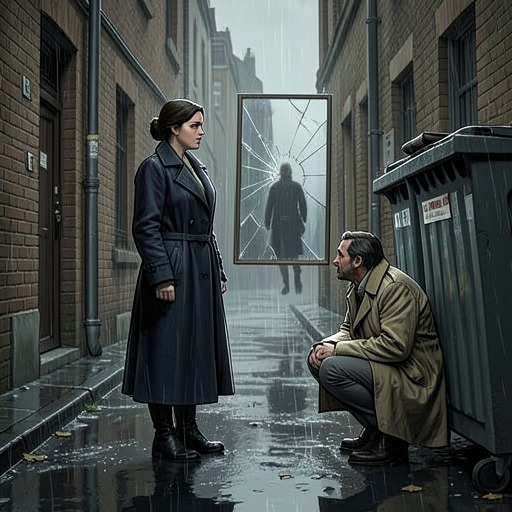
The arrival of the blonde ghost at Old Gossip breaks through Melody’s carefully maintained routine. The figure appears translucent, as though projected on the surface of a lake, dressed in a white outfit that combines bridal and nightlife imagery. She points at Melody and says that others told her to find her. Melody’s immediate reaction is not curiosity but embarrassment and alarm; she wants the encounter to happen nowhere, and especially not in public. The ghost then promises to show her why she sought her out, converting a private supernatural burden into a summons.
Melody follows the ghost beneath a bridge and finds a body lying half in the water. The discovery confirms that the haunting is not an illusion or an eccentric interruption to her morning. It is a concrete murder scene, and her unusual perception has again made her the person who reaches it. The bridge becomes a threshold between the town’s visible life and the concealed violence beneath it, while Melody becomes the living intermediary forced to cross that threshold.
Oskar Freyson, Cindy, and the Murder Investigation
Melody’s connection with Oskar Freyson develops through the investigation but is never purely procedural. Oskar is surprised when she appears at his door, yet he already regards her as the best part of Blackcliff: she has red hair, green eyes, freckles, a pleasant smile, and a professional manner that does not waste his time. His attraction and esteem make her more than a local contact, while his wealth, Shifter status, and personal mystery make him precisely the kind of outsider she once said she needed.
Melody eventually tells Oskar the truth about her gift. She identifies the date July 2, 2011, and explains that Cindy is sitting beside him. Cindy has been following Melody for days, led her to David Fezioni’s body, and was present when the murder occurred. Most importantly, Cindy knows that Oskar did not kill Fezioni, allowing Melody to offer him a defense unavailable through ordinary evidence. Melody also explains the earlier scene under the bridge, when Oskar saw her apparently talking to herself: she had been speaking to Cindy.
This disclosure changes the relationship between them. Melody risks ridicule, disbelief, and exposure in order to tell Oskar what she knows, while Oskar must reconsider every apparently private moment he has witnessed her experience. The revelation also makes Melody a form of living testimony. Cindy’s presence cannot be verified by conventional observers, but Melody can translate the ghost’s knowledge into a claim about the murder. Her gift is therefore both isolating and socially consequential: it separates her from ordinary people, yet it gives her access to a truth that the legal investigation cannot otherwise reach.
Todd Barton refuses to let that access become an excuse for reckless involvement. He tells Melody to go home, take time off, and leave town, insisting that she abandon the case while he follows the evidence. Melody storms out rather than obey. She decides that if Todd cannot discover what really happened, she will. Her stated concern is loyalty to Oskar, but her reaction also shows that she cannot remain a passive witness once the dead have placed knowledge in her hands. The investigation activates a pursuit plot in which her supernatural perception supplies the clue and her refusal to withdraw supplies the momentum.
Desire, Risk, and the Disruption of Normality
Melody initially presents herself as uninterested in dating. She says that she likes selling houses and building her company, and that knowing every local resident too well makes them uninteresting. She wants someone with mystery. The claim is mostly true, but Oskar exposes its exception: if he showed interest, her position would change. Her desire is therefore linked to the same unfamiliarity that threatens her sanctuary. The billionaire Shifter is attractive because he is unknown, but that unknownness also places him at the center of the murder and of Blackcliff’s social anxiety.
Her pursuit of Oskar repeatedly crosses the line between professional competence and personal risk. At one point she breaks into his hotel room, an illegal intrusion that leaves him reaching for his gun before recognizing her. The scene turns danger into charged intimacy: Melody is frightened by the possibility of being shot, then visibly distracted by Oskar’s partly covered body, while embarrassment exposes an attraction she has not fully admitted. The investigation thus operates as a romance structure as well as a mystery. Each step toward hidden truth also brings Melody physically and emotionally closer to Oskar, while each discovery threatens the normal life she claims to prefer.
The narrative’s contrast between Melody’s controlled public persona and her unruly private impulses gives her character its particular tension. She wants the authority of a business owner, the safety of a familiar town, and the distance of a woman who has no time for romance. Yet the ghostly dead interrupt her schedule, murder overrides her professional boundaries, and Oskar’s presence awakens a desire for mystery. Her supernatural sight does not simply add a paranormal feature to an otherwise conventional heroine; it makes concealment impossible. The dead keep returning, and the truths she sees demand action.
Change, Caretaking, and the Later Aftermath
Several months after Elisabeth’s arrest, Melody’s life has expanded beyond the original investigation. She is caring for Bobby, a ten-year-old boy who has suddenly come to live with her. The arrangement is difficult, and both of them are adjusting, but Melody is making it work. Her role has shifted from independent realtor and reluctant ghost investigator toward practical guardian. The change gives material form to her recurring movement from private avoidance to active responsibility: she may wish to escape complications, but she repeatedly chooses to remain present for vulnerable people.
The aftermath also shows her professional skills serving a moral purpose. David’s properties are resold by the government through Melody, and she places the money she earns from those sales into Bobby’s college fund. Real estate, which began as the ordinary occupation she hoped would anchor her to Blackcliff, becomes part of the restoration following violence. Property is no longer merely a means of livelihood or a symbol of the town’s decline; through Melody, it helps secure Bobby’s future while the legal consequences of Elisabeth’s case continue.
Melody’s later position remains unsettled rather than perfectly resolved. Elisabeth’s trial is still ongoing, and Melody is waiting to see whether the circumstances will result in a relatively light sentence. Yet the broader direction of her arc is clear. She does not become normal by suppressing the ghosts, nor does she abandon the town whenever death intrudes. Instead, she learns to combine the parts of herself that once seemed incompatible: the realtor who knows how to manage homes and property, the woman whose desire is stirred by mystery, the witness who can hear the dead, and the caretaker who turns the aftermath of murder toward a child’s future. Her sanctuary survives only by admitting what it contains.